
A24 Horror and Allegory
Heretic's Literalist Heresies

In her enviably shrewd critique of the dunderheaded literalism of much of modern American and European cinema, Vicky Osterweil makes an exception for “A24/prestige horror”, which she notes has been “full of deeply evocative, metaphorical and overwhelming confusion”, often expressed through, “deep saturated colors and inventive camera tricks”. In my own article on Jordan Peele’s Nope (2022) I made a point to praise the plurality of its allegorical storytelling, which struck me as a pretty productive way of resisting the allure of spectacle in a genre film with a $68 million budget.
Some directors on the A24 roster – Ti West; Peter Strickland – are too commited to evoking specific horror subgenres to avoid literalism. Or, rather, their memetic post-modernism sidesteps literalism; but, in so doing, their films: X (2022), Pearl (2022), MaXXXine (2024) and In Fabric (2019) sit – wry or cock-a-hoop – outside any allegorical framework. By contrast, Alex Garland’s Men (2022) clearly invited an allegorical reading, but its symbolic register was so muddled that it ended up gesturing incoherently towards a message about toxic masculinity that was more vibes than valency! Its cinematic syntax was garbled to the point that (the brilliant) Jessie Buckley and Rory Kinnear were, to quote my Mubi review, “left completely unanchored by a long, incoherent middle section, which gestures towards the iconography of folk horror while completely failing to capture the eeriness of the sub-genre or its politics”.
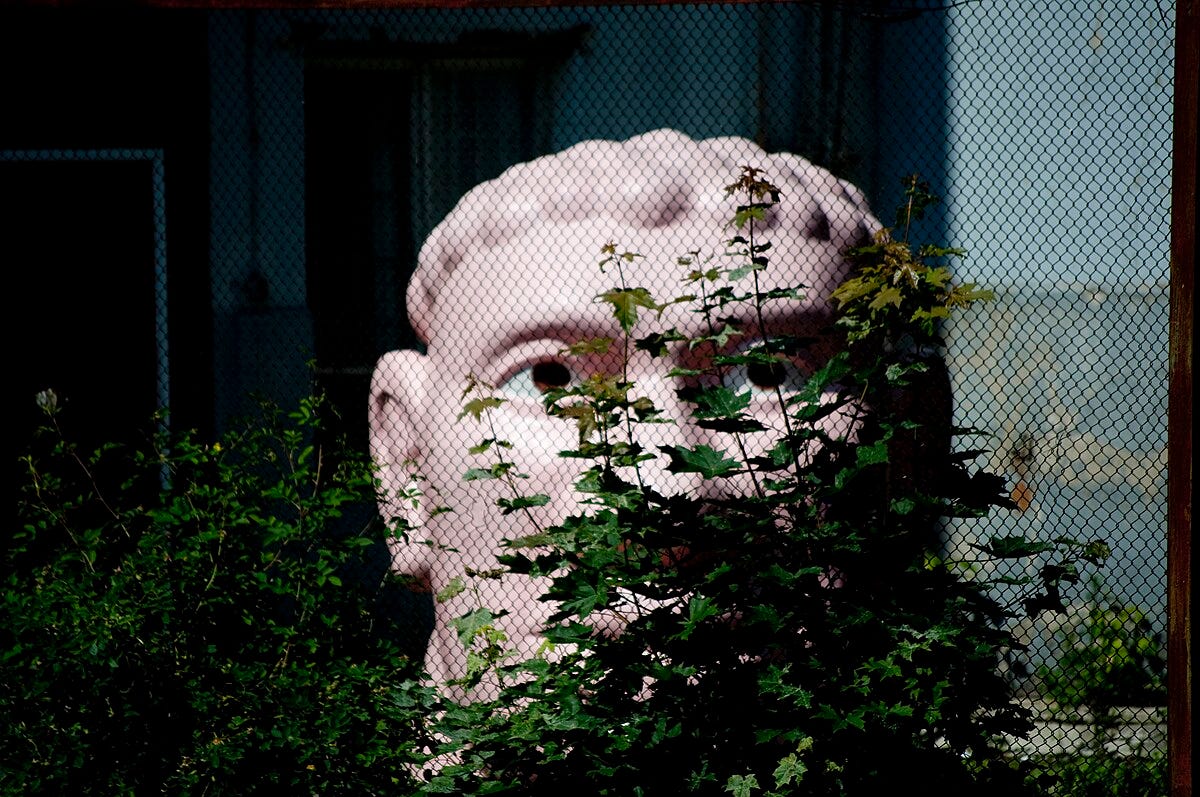
However, the above films were all released in the last half-a-dozen years. In the 2010s A24 produced/distributed Enemy (2014), Under the Skin (2014), The Witch (2016), The Lobster (2016) Hereditary (2018) and – um – Tusk (2014), among others. I personally like some of those films far, far more than others. If I compare my review of Under the Skin (2014):
“we saw an alien's thrown-into-the-worldness and their gradual laying of roots and tactile/ phenomenological awakening”
to my review of Enemy (2014):
“like 'Mulholland Drive' without the charm or intrigue”
it is immediately apparent to me that allegorical multiplicity has little impact upon my enjoyment of a film or how highly I rank it! However, within a culture that often mistakes single-minded confidence for correctness, reducing the experience of films to "takes" explained in a Buzzfeed article or video essay, the ability to tolerate ambiguity and ambivalence strike me as ethical imperatives.
Now, before we turn to the complicated case of Ari Aster, I think it’s worth noting that the films of Robert Eggers provide an interesting exception to Osterweil’s claim that A24-produced elevated horror films avoid the prevailing literalism of contemporary Western cinema. In Eggers’ films, the supernatural is stubbornly real, cackling mockingly at the airy abstractions of metaphor! One of the reasons why The Witch was so alarming upon release was the fact that it had the veneer of other elevated horror films like The Babadook (2014) with monsters that clearly existed to represent something broader and more diffuse, but seemed to treat the titular witch as literally as 17th century New England puritans would. I suspect it would take a writer with a deeper understanding of gnosticism than I have to explain why The Lighthouse (2019) functions more metonymically than it does metaphorically, but I am certain that the lantern is meant to be genuinely possessed of mind-altering qualities. Even if Eggers is more of a fanboy than a fanatic, he takes his visions of dark and slimy things if not as seriously as Lovecraft or Ligotti, at least as seriously as Edgar Allan Poe.
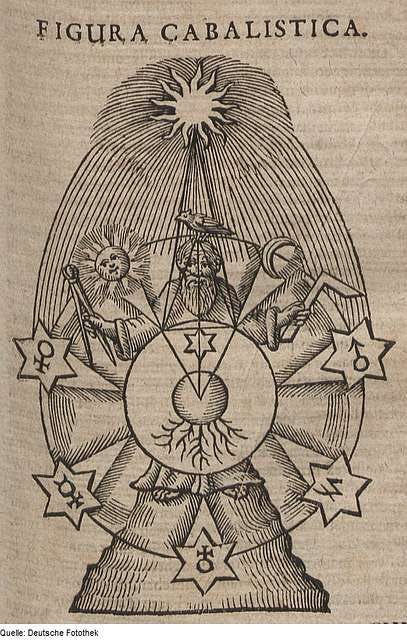
Ari Aster, on the other hand, litters his films with Easter eggs and symbols which point towards suprisingly straightforward allegorical meanings. Hereditary is about grief. Midsommar (2019) is about grief… after a breakup! Perhaps that is why Hereditary impressed me much less upon rewatching, having caused me to gnaw into my own heart in the cinema upon first viewing. The film’s ascent into chaos at the end – judderingly affective when unexpected – is revealed to be as schematic as the rest of the narrative, as per the screenplay’s thematic insistence upon fate. It was, therefore, more honest and less manipulative of Aster to disclose the entire plot of Midsommar in a tracking shot of an illustrative tapestry at the film’s start, but I then felt like I was watching a Rube Goldberg machine elegantly unfold. While the Berman-like focus upon alienation within a romantic relationship (involving emotional abuse, to use modern theraputic language) elevates the material above being an arthouse Final Destination (2000) I had been hoping for the ecstasies of The Wicker Man (1973) and personally felt a little short-changed [though am happy to accept I’m in the minority on this one].
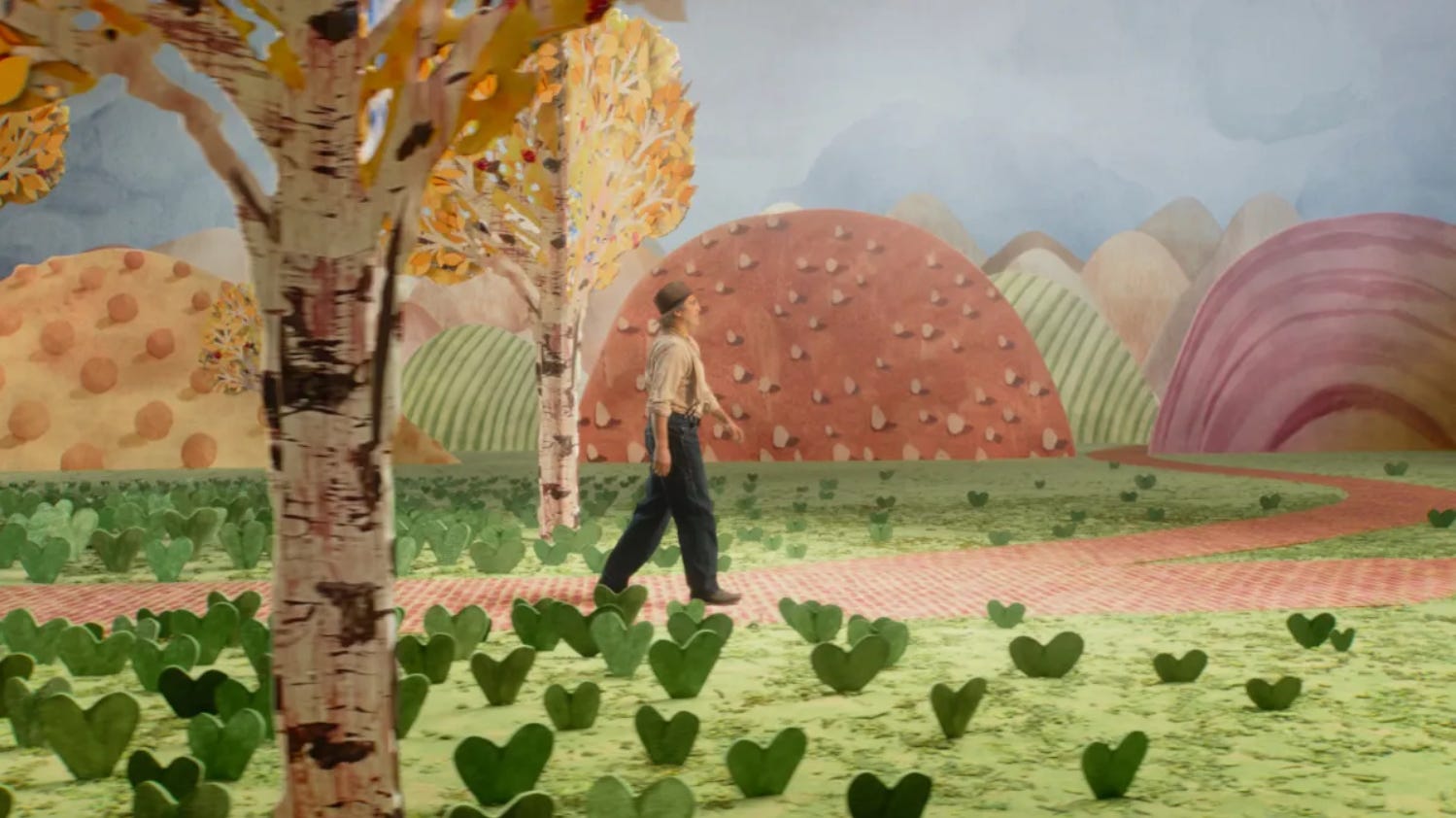
I was also in the minority of liking Beau is Afraid (2023) more than any other Ari Aster film thus released. This maybe because I’m a neurotic with attachment issues linked to my mother… but it’s also because the film is transparent in adhering to a Freudian interpretive framework! The comparitive shallowness of Aster’s approach to allegory mattered to me much less because he swapped in a symbolic schema that has been developed by psychoanalysts and theorists over a decade. Moreover, Cristobal León and Joaquín Cociña are two of my favourite living animators, so the whole – much maligned – middle section was an absolute delight for me. To quote Tim Heidecker, “Beau Is Afraid was so fuckin good. I feel only embarrassment for those who were angered by it”. In fairness, it was basically an extended episode of Tim and Eric’s Bedtime Stories (2013) but I digress…
So, why did Heretic (2024) irk me? It has a decent premise: Two Mormon missionaries, Sister Paxton and Sister Barnes (Sophie Thatcher and Chloe East) visit the home of the eccentric Mr Reed (Hugh Grant) who subjects them to increasingly disturbing trials (and increasingly self-satisfied lectures!) to test their faith.
//Spoilers for Heretic follow//
Reed first appears to be something of a Richard Dawkins type, arrogantly secure in his own scepticism. Mid-way through the film he seems closer to Jordan Peterson, with his claims of archetypal universality – that, for instance, Christ is a mythic figure that essentially belongs to the same archetype as figures found in other religions across the globe. Finally, Reed is revealed to be some kind of strange nihilistic sadist, a cross between Michel Foucault and Thomas Ligotti, who believes that the only true religion is the exercise of power within a universe of meaninglessness.
Sister Barnes is murdered by Reed but Sister Paxton eventually escapes to a forest where a butterfly lands on her hand, possibly representing Barnes (so says Wiki), possibly representing her faith or the wonder that exists in the world. Cut to credits.
Now, trying to peel back Reed’s personas to work out what his actual belief system is, provides a fair amount of intrigue. Thatcher, East and Grant all do well with the material, making dialogue that could sound didactic or stagey sound realistic and charged with tension. I also appreciated that a film which is ultimately about a serial killer playing mind games with his victims, was not as gleefully nasty as the likes of the Saw films, but largely “cerebral” (Rotten Tomatoes via Wiki).
However, I have very specific objections as a Unitarian!!!
While the filmmakers certainly don’t endorse Reed’s worldview (and, indeed, reveal him to be a rather pompous and intellectually-blinkered sadist) the dialectic of the film is a binary between faith VS non-belief. It strikes me as a sensible choice to make the two protagonists Mormons rather than garden variety Christians because it helps avoids stacking the deck for the majority of the (non-Mormon) audience in terms of their sympathetic (or ideological) alignment. The film is going to be most effective for viewers who engage with the belief systems of all three characters from a position of curiosity rather than dismissal.
However the film’s screenplay confuses syncretism with perennialism and this is embodied in Heretic’s literal architecture.
In short, syncretism refers to melding or combining or holding space for different religious beliefs within a faith. Perennialism is the idea that there is a single Truth underlying all religious and spiritual thought. Heretic seems to posit cynical atheistic perennialism as the only logical form of syncretism. It does this through structuring the film according to the followers’ journey through and down Reed’s mousetrap-like house, by which a hexagonal library is collapsed into a binary between two – on which one is written ‘Belief’ and on the other ‘Disbelief’, which is further collapsed into a singular basement where Reed imprisons his victims.
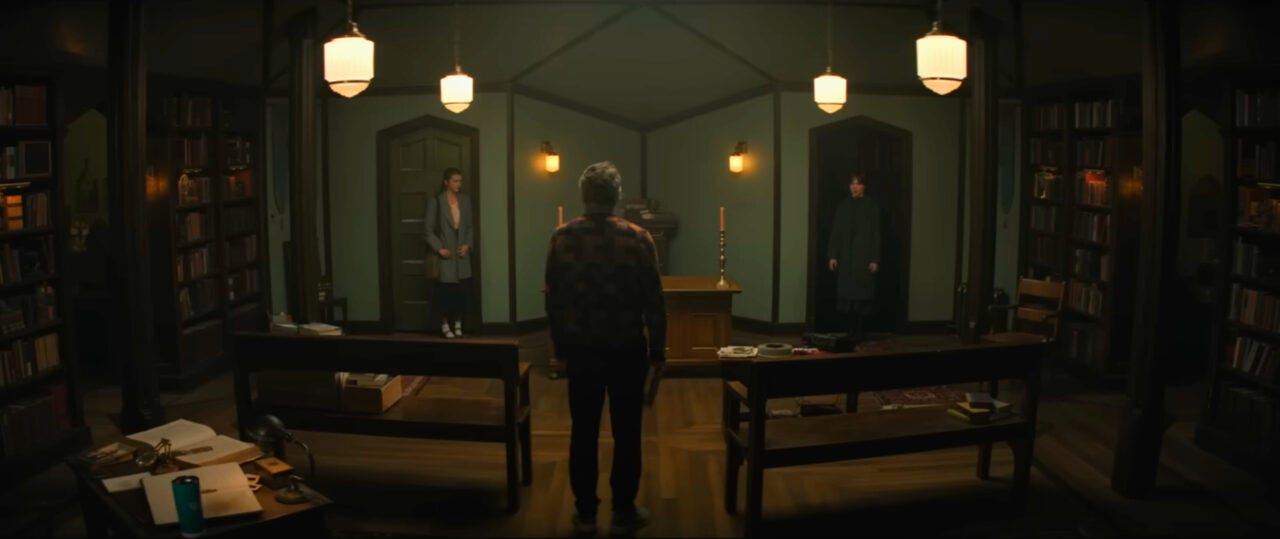
So, while there is nothing in the film’s dialogue which explicitly disavows the possibility of holding seemingly incompatible aspects of different faiths together in eternal suspension, the film’s structure and mise-en-scène renders this unvisualisable (and unimaginable within the diegesis of the film). This might be necessary to allow the film to function as a thriller, but it seriously undermines the “metaphorical and overwhelming confusion” which Osterweil praises in A24’s films since it shuts down the possibility of a sincerely held ambivalent faith.
Charitably it should be possible to view the butterfly at the end of the film as a symbol of ontological indeterminacy… however to make this reading coherent the butterfly could have been shown existing outside of Reed’s house before as well as after the followers’ experiences. With the butterfly only appearing to the traumatised Sister Paxton at the end of the film, the viewer is cued into interpreting the butterfly psychologically. Arguably the ambiguity (or, simply, fuzziness) of the butterfly as a symbol at the end of the film actually does more to undermine Reed’s (and the film’s) theological worldview than a more over-determined symbol would, however!
The above probably seems like a weirdly persnickety issue to have with a decent film, but I think it speaks to the fact that in constructing a mystery box film Scott Beck and Bryan Woods have undermined its allegorical complexities… which is fine… but I also genuinely think this particular socio-political moment requires films with more, not less, allegorical complexity, ambivalence and uncertainty. As a film lecturer, time and time again students (especially male students) would name Christopher Nolan and Quentin Tarantino as their favourite filmmakers. Now, Memento (2000) and The Prestige (2006) or Pulp Fiction (1994) and Inglourious Basterds (2009) are all wonderfully structured, slickly made films, but they require very little moral or aesthetic imagination on the part of viewers [I love Adam Cadre’s searing critique of Inglourious Basterds; the other films strike me as less noxious]. Try as I might, I achieved little headway encouraging the students to appreciate the poetic ambivalences of, say, the films of Mohsen and Samira Makhmalbaf or Raúl Ruiz.
Now, in fairness, a lot of 18-year-olds cannot be expected to enjoy the slow cinema of the Iranian New Wave or the weird allegorical density of Ruiz’s work. Fair enough! However, I think horror cinema at its best is able to achieve allegorical sophistication and an embrace of ambivalence and ambiguity while still remaining riotously entertaining. While Heretic didn’t quite work for me, here are some other recent allegorical horror films that did:
The Crescent (Seth A. Smith, 2017) is arguably a mystery box film. Now, I’m usually with David Lynch in believing that mysteries should be kept alive not solved; however, The Crescent’s tale of a grieving mother and young son contains enough emotional depth and sheer eeriness that it still manages to linger. I keep planning to write an blog post or paper on recentish horror films that do interesting things with domestic space, especially through the perspective of a child, and The Crescent is a film I am really keen to write about.
The Substance (Coralie Fargeat, 2024) achieves a visceral affectivity gloriously in excess of its symbolic framework while Heretic is reducible to only its allegory of belief VS disbelief. As such, while many have critiqued it for depicting the monstrous feminine archetypes it is seemingly attempting to critique or dispel, it taps into how the existence of these archetypes conditions the body and is deeply felt by women subjected to all that shit on a daily basis! I found Demi Moore chucking around chicken and screaming at some entitled Nice Guy to “FUCK OFF” deeply cathartic so I can only imagine how enjoyable it was for my sister and female friends who also loved the film!
A Place Without Fear (Susanne Deeken, 2024) is an astonishing animated avant-garde horror film that circles around the body and domestic space. It seems more personal than allegorical in a socio-political sense, but it also feels like it belongs to a second-wave feminist “the personal is political” space.
Nosferatu (Robert Eggers, 2024) is Eggers’ most full-realised vision to date and works simultaneously as an allegory for the rise of fascism and the processing of sexual trauma. It exists in interesting relation to Murnau’s 1922 original and Herzog’s 1979 version. I’ve previously argued that Eggers’ films don’t function allegorically and here the viewer is certainly meant to take Bill Skarsgård’s Count Orlok as having an earthily embodied presence, but I don’t think that shuts down more abstract readings.
Interesting read, and forgive me, for I only discovered movies properly when I lived with a film student in Vegas who sniffed abstraction so hard that they absolutely hated the Maltease Falcon being assigned as a film. None the less you captured something that I've felt with A24 and strangely, weird fiction/horror short stories.
It's funny to mention Thomas Ligotti because he's a good example. I always found him to be strange, I love his stories, but then they always go off too far (Mrs. Rinaldi's Angels could've stopped halfway and been excellent.) sometimes I feel like that one "grog can only understand surface level themes" meme. But that's okay because you know it's there and grab onto tendrils. You can work out what things meant, you can "stew" in a sense. The Lighthouse, was a good example, because I kept chewing around all the myths and knowledge had to place symbols. In the pizzeria around the corner, we spent hours talking about it, a nice cross section between my background and a friend's cinema background. We were both lost at sea, but it was a nice feeling.
On the other hand you have John Harrison whose "weird fiction" short stories are a mess - of trying to do something bigger but being banal and reduced to either absurdity (Cicisbeo) / or boring lazy metonymy (Missiles) and I do feel a lot of the A24 things end up slipping into this category. Enemy was a good example and it seems Heretic does the same. Getting lost in the sauce can just flush away everything you set up and it's almost frustrating.
I've been reading Joel Lane's The Anniversary of Never and it's probably the closest to Eggs but for modern times. I've never found a short story that really shows the abyssal state of my hometown in England, and it's almost sickening to me in a good way. I gave the story to my friend and they came back with this whole theory of the nature of death and a world that has been neglected. He sold this bubbly, Wes Anderson loving creature a surprisingly accurate feeling and horror of the abandoned towns of England.
Yet I find it absolutely impossible to navigate this space, and the same with A24 even talking to cinema or weird fiction fans alone. Sometimes I feel like "grog" and I've missed some literary or cinema technique, but sometimes, sometimes it is just bit shallow and messy. That's a little refreshing.
Perhaps The Substance is also a good litmus test to see if you've gone too far one way or the other.
Interesting read, Thank you,